



You’ve decided on WordPress for your next digital project. Great! That is a smart strategic move. You are in excellent company. This platform powers over 43% of the internet, serving global entities ranging from The White House to NASA. These organizations use WordPress to leverage its open-source flexibility, robust REST API capabilities, and to avoid proprietary vendor lock-in.
But now, you face a decision that is just as important as the software itself: who is going to build it for you?
Don’t look at the choice between hiring a freelance WordPress developer or engaging a full-service agency through the lens of a budgetary math problem. It is a strategic decision about risk tolerance, project complexity, and maintaining control over your website, so you must match your project’s needs to the right service model to ensure long-term success.

Get matched with the developer
that is perfect fit for your WordPress or WooCommerce needs.
Start a project
Understanding your options
A WordPress development agency is a company that provides multi-disciplinary teams for complete website projects. A freelance WordPress developer is an independent contractor who offers flexible, cost-effective execution for specific tasks. To make the right choice, you must understand the operational DNA of each model.
WordPress development agencies vs freelancers: core differences
| Feature | Freelance WordPress Developer | WordPress Development Agency |
| Primary value | Offers accessibility and economic efficiency as the bedrock of the ecosystem. | Aggregates specialized labor to reduce risk and provides strategic consulting. |
| Communication | You communicate directly with the engineer writing the code, creating tight feedback loops. | Provides a layer of management and strategy that sits above raw code production and site maintenance. |
| Risk factor | High: If the developer becomes ill or unavailable, the initiative stalls immediately. | Low: Institutional memory ensures the project continues even if specific staff members leave. |
| Continuity | There is no backup if the primary point of contact disappears. | The agency is contractually obligated to replace resources to ensure no interruption. |
Team structure and expertise allocation
The most significant limitation of the freelance model is that a single developer, regardless of their skill, rarely masters the full stack of modern web disciplines, which includes DevOps, PHP backend code, design, and technical SEO. While they may excel in one vertical, they often lack the bandwidth to execute comprehensive testing and security auditing simultaneously.
Agencies solve this by deploying a curated squad rather than an individual. This multidisciplinary team typically includes:
- A project manager to handle logistics and timelines.
- A UI/UX designer to ensure the interface is accessible and responsive.
- Backend and frontend engineers to handle complex logic and visual elements separately.
- A QA specialist to test the site across fragmented device landscapes.
Project management and communication models
Hiring a freelancer often imposes a “management tax” on you as the client. Because freelancers focus on code, you must often act as the general contractor, clarifying requirements, coordinating timelines, and piecing together different specialists to cover gaps. This disintermediation removes bureaucratic layers but increases your cognitive load.
Agencies absorb this management overhead within their fees, allowing you to focus on business strategy rather than technical execution. Mature agencies typically distinguish between two key roles to optimize outcomes:
- The Account Manager functions as your strategic liaison, identifying growth opportunities and managing the overall relationship.
- The Project Manager focuses internally on the iron triangle of scope, budget, and timeline to manage day-to-day logistics.
This dual-layer structure ensures that your long-term strategic vision is not consumed by the tactical minutiae of daily development tasks.
The agency route
Hiring a full-service agency is a process-driven partnership designed for scale. If your organization requires institutional reliability over freelance agility, understanding the agency workflow is essential for aligning your internal resources.
What to expect: the typical agency process
What’s the typical process when you hire a WordPress agency? It rarely begins with coding. Agencies typically operate on a structured, four-phase timeline.
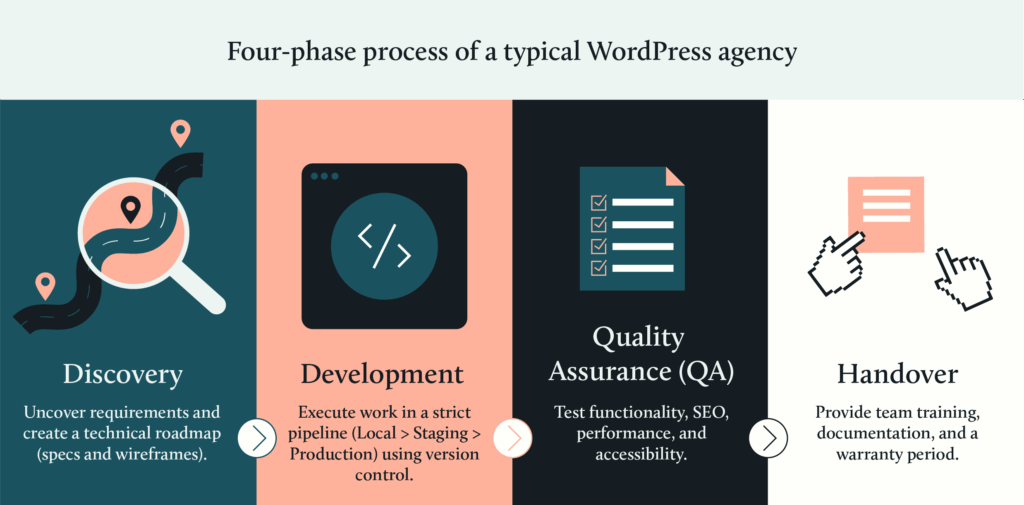
- Discovery: This paid phase uncovers hidden requirements and defines success metrics to create a technical roadmap. Deliverables often include functional specifications and wireframes to prevent budget-killing scope creep.
- Development: Work happens in a strict pipeline, moving from a local environment to a staging site for your review, and finally to production. Agencies use version control to manage every line of code.
- Quality Assurance (QA): Before launch, the site undergoes rigorous testing. This covers functionality, SEO settings, performance optimizations like caching, and accessibility compliance.
- Handover: The process concludes with training for your team, a warranty period for bug fixes, and documentation explaining your code architecture.
Top WordPress development agencies
The WordPress ecosystem features specialized firms capable of enterprise-grade delivery in eCommerce, eLearning, and general development scenarios. Some of the top-rated WordPress development agencies include:
- 10up: A WordPress VIP Partner renowned for engineering best practices and complex custom development, with project minimums typically starting at $75,000.
- Human Made: Pioneers in headless WordPress solutions who focus on enterprise digital experience platforms.
- rtCamp: An agency specializing in enterprise-scale solutions and complex migrations from other platforms like Drupal.
- WebDevStudios: A veteran firm known for robust custom development and authoring definitive content on WordPress solutions.
- WisdmLabs: Recognized experts in the eLearning niche and complex WooCommerce solutions.
Best practices for agency collaboration
Success requires you to adapt to the agency’s structured workflow. Client delays in providing content are often the primary bottleneck, so be prepared to meet strict deadlines for asset delivery. While the process involves longer timelines than freelance work, the outcome is predictable delivery managed by dedicated project managers.
The freelancer route
For many businesses, the freelance market is the most significant advantage of the WordPress ecosystem. It offers a vast spectrum of talent, ranging from entry-level practitioners to senior architects capable of building custom plugins.
Benefits and limitations of freelance developers
The primary appeal of the freelance model is economic efficiency and the removal of bureaucratic layers. You communicate directly with the engineer writing the code, which often leads to tighter feedback loops and a deeper understanding of technical nuances. This agility allows for rapid scaling up or down based on immediate project demands.
However, this model imposes a significant cognitive load on you as the client. A single developer is rarely a master of the full technology stack, meaning they may excel at plugin development but lack the bandwidth for comprehensive testing or security auditing. Perhaps the most critical vulnerability is the risk factor involved in a freelance engagement. If your developer becomes unavailable, your initiative stalls because there is no built-in redundancy. Additionally, freelancers rarely carry the liability insurance necessary to protect your organization from data breaches or coding errors.
Finding and vetting WordPress freelancers
Generalist platforms like Upwork or Fiverr often suffer from a race-to-the-bottom dynamic. When clients post jobs, freelancers bid against each other, often undercutting prices to win, which inevitably leads to cutting corners and poor communication. While some platforms offer ‘Expert-Vetted’ badges, the fundamental model remains a bidding marketplace where price sensitivity often trumps quality.
Cost considerations
Understanding the financial implications of your project requires a nuanced view of the market, as rates are not standardized. Cost is a function of geography, expertise, and the specific engagement model you choose.
Understanding WordPress development costs
How much does WordPress development cost? The price tag is highly elastic and depends entirely on the provider’s positioning in the value chain.
- Basic informational site: These typically range from $2,000 to $7,000.
- Custom business site: A tailored solution often falls between $7,000 and $10,000.
- eCommerce/complex site: Projects requiring transaction logic generally run from $8,000 to $20,000+.
- Enterprise-grade build: Large-scale implementations can cost anywhere from $50,000 to over $80,000.
Based on these estimates, here’s how much you will normally end up paying a WordPress developer.
- Entry-level freelancers charge $15–$40 per hour. These are good for basic customizations, but may often lack deep knowledge of security or performance optimization.
- Senior architects charge $100–$200+ per hour. While the rate is higher, a senior expert offers the advantages of speed, professionalism, and higher WordPress expertise.
Agency vs freelancer pricing models
Freelance rates often reflect the you-get-what-you-pay-for adage, with lower rates frequently correlating with technical debt. Agencies operate differently; their fees represent a blended rate that covers not just the development, but also project management, quality assurance checks, and additional overheads.
- Small/boutique agencies: typically charge $100–$150 per hour.
- Mid-sized agencies: rates usually fall between $150–$200 per hour.
- Enterprise agencies: top-tier firms charge $200–$400+ per hour.
Agencies argue these higher upfront costs are justified by the Total Cost of Ownership (TCO), as proactively preventing bugs and architectural failures saves money over the software’s lifecycle.
Hidden costs and value considerations
When evaluating a freelance proposal, you must account for the hidden cost of managing the project yourself, which may include writing tickets and testing functionality, which has a quantifiable financial value. Additionally, hiring an uninsured freelancer transfers significant liability risk to you or your organization, whereas agencies typically carry technology errors & omissions and cyber liability insurance.
Finally, consider long-term website maintenance. Freelance retainers often charge $50–$250 per month for basic updates. Agency retainers, which include security monitoring and regular backups, can range from $300 to $1,500+ per month.
Find your specialized expert with Codeable
For many businesses, the choice between a risky, unvetted freelancer and an expensive, full-service agency is a dilemma with no attractive option. Codeable is a platform specifically designed to solve this middle-market problem by productizing trust and quality assurance. It offers a safe harbor for businesses that have outgrown generalist platforms but are not yet ready for a $50k agency contract.
Quality over cost: the Codeable difference
Codeable operates on a different paradigm than typical freelance sites. It is an exclusive, closed WordPress developer hiring platform that accepts only the top 2% of applicants. To get in, developers must pass a rigorous multi-stage vetting process that includes:
- Professional review: A manual screening of their portfolio and CV.
- Communication testing: Ensuring they can communicate complex technical concepts clearly.
- Coding exams: Real-time assessments of problem-solving skills and personality.
- Trial period: New experts are monitored closely before being fully certified to ensure consistency.
A pricing model designed for success
Instead of freelancers underbidding each other to win your business, Codeable lets interested experts discuss your requirements in a shared workroom and submit estimates privately. You then receive one single price, which is the average of those estimates. This mechanism ensures developers are paid a fair market rate, typically $80 to $120 per hour, and removes the incentive to cut corners.
Agency-style guarantees
Codeable offers agency-like safety nets even in a freelance relationship. The platform’s service fee funds critical protections such as:
- Escrow: Your funds are held securely and only released when you mark the project as complete.
- 28-day warranty: If a bug related to the scope appears within a month, the developer must fix it for free.
- Dispute resolution: If a developer becomes unavailable, Codeable can replace them with another expert to ensure project continuity.
Your choice between a WordPress agency, a freelancer, or a specialized platform like Codeable directly impacts the future stability of your digital infrastructure.
If you are an enterprise organization where a single minute of downtime equates to thousands of dollars in lost revenue, the high premium of a full-service agency might be a necessary insurance policy. Conversely, if you are bootstrapping a blog with zero revenue, a generalist freelancer from an open marketplace is a viable, low-risk starting point.
However, for the majority of growing businesses, the sweet spot lies in the middle: you need the code quality and reliability of an agency without the six-figure overhead. Partner with Codeable for enterprise-grade code, clear intellectual property protection, and agency-level warranties, as well as the agility and direct communication of a dedicated expert.
If that sounds like a great plan, find your vetted expert on Codeable today!

20 000+ businesses of every shape and size have already trusted us to hire WordPress developers and scale their growth.
 Dream It